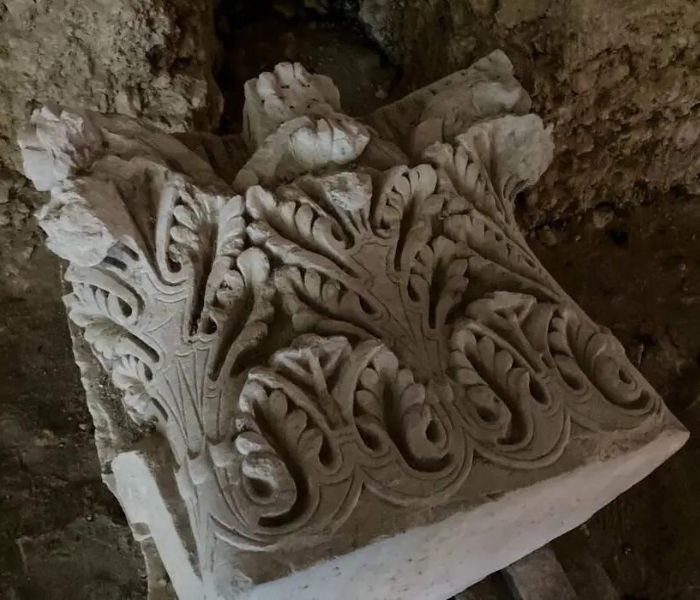

Last week, I decided to take Lucas and Morgana to wander around the medieval fortress of Villebois-Lavalette. It is only about a 20-minute drive from us, and it’s currently school holidays, so I thought we could learn a little more about the local history. Although we live in Perigord Vert (green périgord) of the Dordogne department, we are very close to the border, and the village of Villebois-Lavalette is in the Charente region.
There were guided tours around the chateau, but when we arrived, the guided tour had already left, and it was in French, so we did a self-guided tour with an English booklet. This cost me €3.50 and was free for the children, who are both under 12 years old. You can pay with cash or a card, but to use the card, you need to spend a minimum of €10. When you arrive, go through the entrance gate and to the right, you will find the front desk to pay, which also has a little gift shop selling drinks, guidebooks and cornuelle’s. Cornuelle’s are délices charentais (Charente speciality), triangular shaped biscuits with sugary decorations on. The cornuelle’s are baked in the local boulangerie (pastry shop).
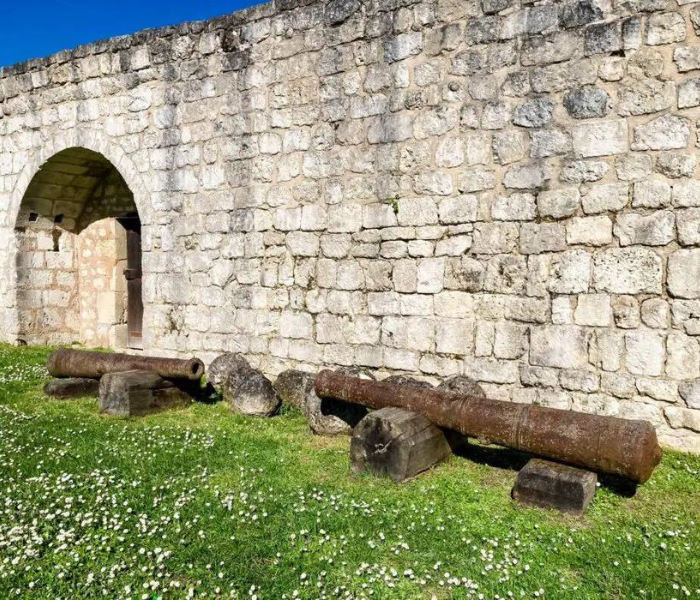
The history of the castle of Villebois-Lavalette
The Château de Villebois-Lavalette, perched atop the 200-meter-high Puy Sanseau, has witnessed the construction of four distinct castles over a millennium—a history that archaeology helps us piece together today.
Around the Year 1000
The first construction, a wood motte-and-bailey castle, was built in 959 by the lords of Villebois, who were allies of the Taillefer counts. They constructed a wooden tower on a man-made hill.
12th and 13th Centuries
Throughout the late 12th and early 13th centuries, ownership of the castle changed hands multiple times. It was rebuilt in stone and fortified with a seven-tower enclosure during this period. The lord’s residence was expanded into a large, multi-story structure supported by circular buttresses. A Romanesque chapel within the grounds served the spiritual needs of its inhabitants.
End of the Middle Ages
The barons of Mareuil later added another noble residence, enhancing the castle’s defences with additional drawbridges and towers. In 1597, after initially attacking the castle during the religious wars, Jean-Louis Nogaret de La Valette, Duke of Epernon, purchased it. By 1622, Villebois was elevated to a duchy-peerage, renamed Valette in honour of its new owner.
The Classical Era
From 1667, Philippe de Montault de Bénac and Susanne de Baudéan de Neuillant de Parabère, the Duke and Duchess of Navailles, constructed the fourth and final castle on the existing foundations. This new building, designed in the classical style, was intended as a pleasure residence surrounded by a park. Their contributions also included the addition of market halls and a convent to the village, enhancing the local architecture significantly.
Modern Times
Following the Revolution, the castle served various purposes, including as a school, gendarmerie (police station), and prison. A fire in 1822 partially destroyed the 17th-century residence. In the early 20th century, Maurice De Fleury bought the castle. By 1980, it had fallen into ruin. Still, restoration efforts by his grandsons, Philippe and Bernard (known by his stage name Bernard Lavalette), along with the amis du château (Friends of the Castle association) and local government, helped rehabilitate its historic ramparts.
21st Century
In 2000, the castle was acquired by Norbert Fradin, a Bordeaux developer and patron of heritage conservation, who continued the restoration efforts. A significant discovery in 2006 of a 12th-century room highlighted the castle’s continuous capacity to reveal new historical insights.
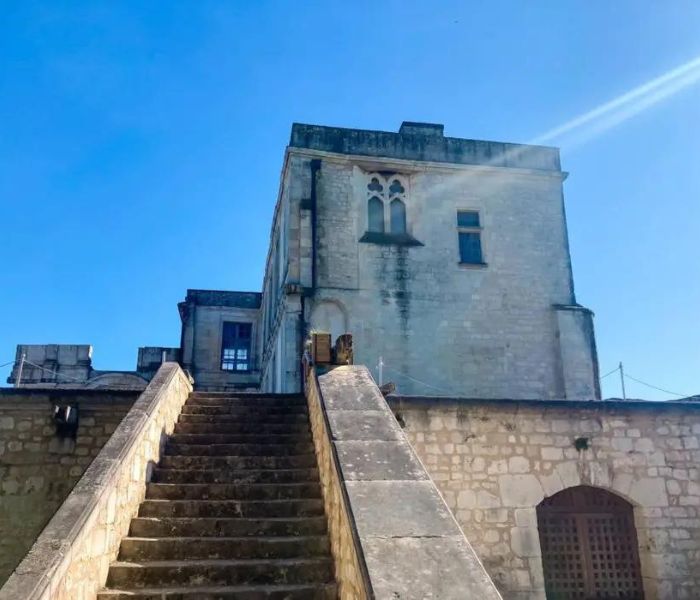
Today, the Château de Villebois-Lavalette, with its commanding seven round towers, stands fully classified as a Historic Monument (2005), a testament to the extensive archaeological and restoration work that has illuminated its past and secured its future.
Family-Friendly Activities: From Escape Games to Guided Tours
- Guided tours are available for the chateau and also the village of Villebois. Check their website for days and times. They vary depending on the season.
- Enjoy an escape game. One is the “mystery of the cornuelles,” where you investigate, search, and find who is responsible for the disappearance of baker Honoré Cornélius, the sole holder of a mysterious recipe. The second is the “les pipoles” treasure hunt, where you go hunting for the characters who have spanned the castle’s history. Search for information, codes, and objects to enter the Pipoles box. Both of these games must be booked before arriving.
- The Chateau hosts various cultural events throughout the year, including medieval workshops, falconry displays, and reenactments. These activities are not only fun but are also educational, providing a hands-on experience of history.
Planning Your Visit
When planning your visit, consider these tips to make your trip as enjoyable and stress-free as possible:
Best Time to Visit
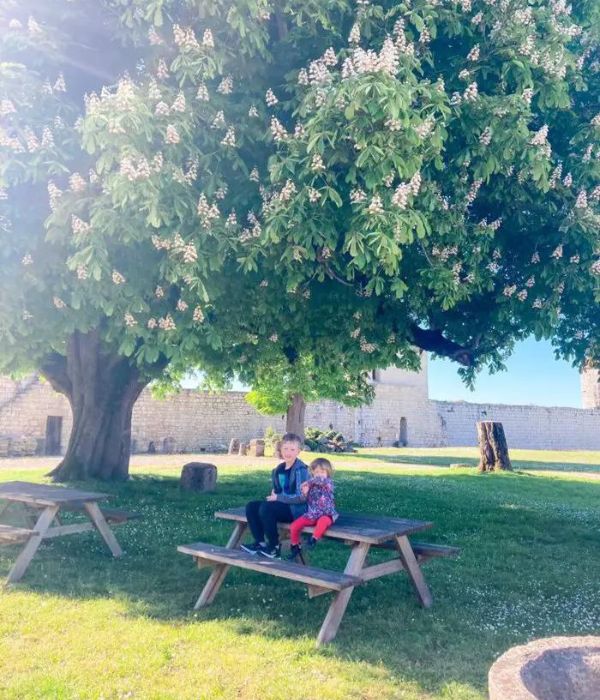
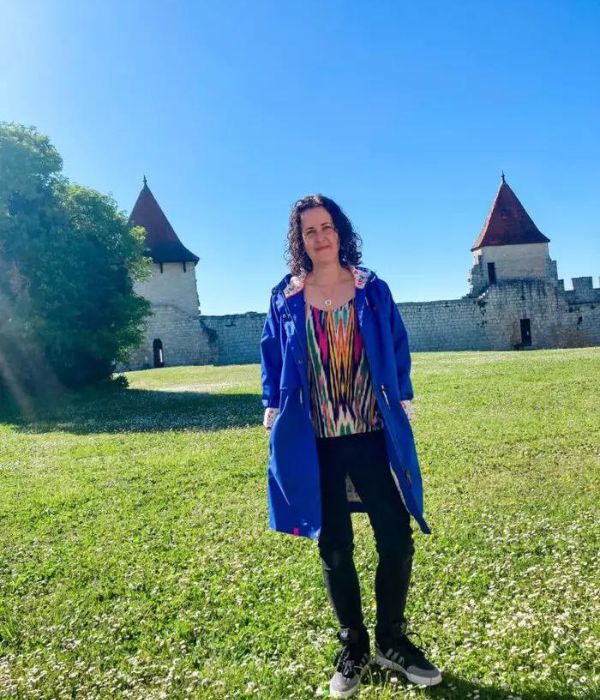
Late spring and early autumn offer pleasant weather, ideal for exploring the grounds and participating in outdoor activities. It can still be windy and have showers, so make sure you are dressed for the weather. Although it looked sunny in the photos, there was a cold wind when we visited. Thankfully, I keep my Lighthouse Pippa coat in the car. I adore the Indigo shade, Teflon coating, and built-in hood, which offer excellent waterproofing while ensuring outstanding breathability. The coat features a soft floral lining that stands out when the cuffs are turned back. The chateau will be open more during the Summer, but be prepared for the heat. It does get very hot in July and August.
Amenities at the Château
The site includes restrooms and a small café. The self-guided tour has booklets in French, English, German, Dutch, and Spanish. The guided tour gives you access to the full chateau, whereas the unguided tour only gives you access to the lower part.
Restaurants
If you are looking for somewhere to eat, there is Le Lavalette, which serves modern European food, and Hall Dente, which serves French and Italian food. Both usually need to be booked ahead and are in the village’s main square. If you don’t mind travelling further, head to the heart of Angoulême for Le Jardin de Kashmir, which serves Indian and Pakistani food, or Garretts if you fancy an American diner-style meal. Lucas loves the burgers there, and I can recommend the fajitas.
Nearby attractions
5 minutes from the chateau is Super U, a supermarket and a petrol station. There is a weekly market on a Saturday in the main square of the village. Near the tourist office, there is also a children’s play area. Less than 10 minutes away is Chateau de la Mercerie. The city of Angouleme is 30 minutes away, with shops, restaurants, museums, cinemas, soft play, and bowling. Aubeterre-Sur-Dronne is 30 minutes away, a beautiful village with a small beach, boutique shops, restaurants, and a monolithic church. The tourbierres of Vendoire are about 10 minutes away and next door to those is camping des tourbières – gîtes that serve drinks, ice creams, and a maize maze to explore.
The history of the Cornuelle
The Cornuelle is famed for its association with the Rameaux Fair, where Christians often incorporate a sprig of boxwood blessed in religious ceremonies. Legends suggest that pilgrims destined for Saint James of Compostelle would carry these pastries as a spiritual token.
Debate surrounds the pastry’s triangular form. Some interpret it as a nod to the Holy Trinity, encapsulating the Father, Son, and Holy Spirit, while others believe it may echo relics of deep-seated pagan customs.
The credit for this confection goes to Jean Moreau, a baker who, after a seven-year sojourn across France at the turn of the 20th century, chose to make his home in Villebois-Lavalette. Bringing a revered bakery recipe with him, he commenced his craft near the local church, initially in the historic Corlieu residence. As time passed, he transitioned to a prominent street, where his anise-flavoured pastry quickly rose to prominence, symbolising the Rameaux Fair’s bustling atmosphere. It became customary to purchase these cornuelles in dozens, enjoying them with wine among friends.
Jean’s grandson, Guy, recounts his father, Michel, continuing the legacy with an impressive production that filled their home. Reserved for Guy were merely the trimmings from these baked goods, a privilege captured in a 1930s photograph adorning the family shop.
Surviving through the century, Jean Moreau’s original recipe is a guarded treasure amongst bakers, handed down with the passing of the business torch. The recipe was officially documented with the National Institute of Industrial Protection in February 2011 to safeguard this longstanding culinary heritage. Villebois Lavalette proudly upholds its status as the epicentre for cornuelle enthusiasts, offering the delicacy year-round in bakeries, the community hub, and the castle. Nowadays, patrons delight in choosing from four exquisite variations of the cornuelle, ranging from the traditional recipe to innovative versions infused with green anise, or filled with chantilly or a delicate cream. The Rameaux Fair remains celebratory when local bakers present two sizable cornuelles to the public, a treat many savour in the festive street parade.