
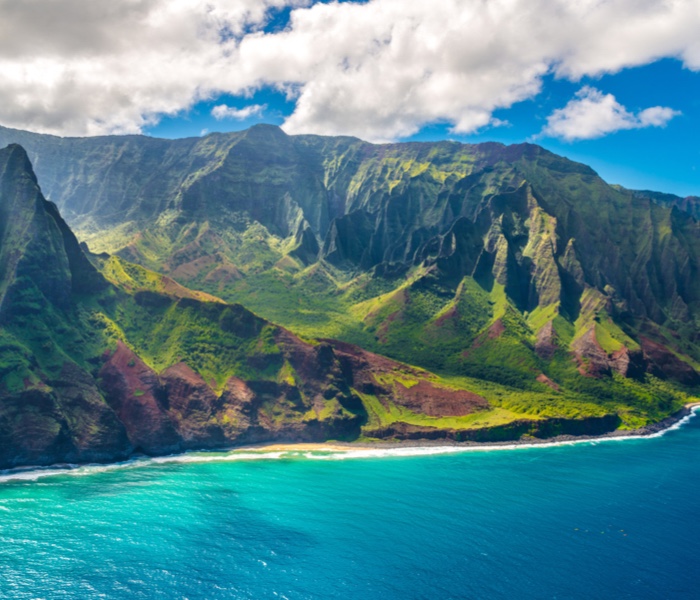
For many people, destinations whose rainy season period coincides with their holiday dates don’t usually feature high on their list of possible holiday choices. However, where the tropical islands of Hawaii are concerned the term rainy season, which occurs here from November to March, may be a little misleading.
Hawaii, in common with many other islands of the world, whose climates and weather patterns are so closely dependant on the oceans in which they lie, has many micro climates. This means the weather can be doing very different things from island to island and even more markedly from different locations within the same island.
If you are planning on island hopping in Hawaii, some islands, such as the Big Island, have a very low average annual rainfall and, where rain does occur, it is normally short-lived. As a general rule the western and southern sides of the islands experience less rain and have generally warmer temperatures than the east and north sides. Therefore, if you choose your destination carefully, even in the rainy season, you may experience little or no rain at all.
There are several benefits with regard to visiting Hawaii in the rainy season, once the concerns regarding the likelihood of rain have been addressed. Hawaii’s latitude and proximity to the equator mean that temperatures stay relatively high all year round and, as the rainy season months coincide exactly with the northern hemisphere’s often chilly winter, it is a much sought after destination during this period.
Escaping the worst of snow, ice or just miserable grey skies is high on the agenda for many people and the idea of Christmas at the beach has become especially popular. Many people find the high humidity and more extreme temperatures of summer uncomfortable and opt for a winter break where temperatures are a little more manageable while still guaranteeing sunshine. Winter temperatures typically range between 23 degrees C to 28 degrees C during the day, depending on elevation, and sticky night temperatures are avoided – averaging around the 18 degrees C mark. Places with a higher elevation, such as upland and mountain regions of the Big Island, Maui and Kokee State Park on Kauai experience far lower temperatures in the winter. These can dip to 0 degrees C and are best avoided if you prefer more heat.
For anyone interested in wildlife then the rainy season in Hawaii offers a particular treat. Every year, thousands of Humpback whales stop by Hawaii from mid December to May while migrating south from their Alaskan feeding grounds of summer. Whale watching tours, which operate from all the large islands, have become a popular tourist attraction and no amount of watching wildlife programmes on TV can quite prepare you for a first hand experience with these giants of the ocean.
A whale spout alone can be a spectacular sight when viewed for the first or even the hundredth time and these explosive jets rise so high that they are often visible from land. Humpback whales can be quite acrobatic, heaving their enormous bodies almost completely clear of their water before returning with an ear splitting crash. Although such a sight is not guaranteed it is far from rare and you may be lucky enough to witness it.
Another major benefit of visiting Hawaii in the winter months is in regard to various sporting events, both from a participant’s and spectator’s point of view.
Autumn and winter are when the large and powerful ocean swells hit the shores of Hawaii which means big wave season for surfers. During this time Hawaii not only attracts recreational surfers from around the world wishing to test themselves in some of the most challenging surf conditions globally but the world class quality of the waves makes Hawaii the venue for several professional competitions.
The Association of Surfing Professionals (ASP) hold a leg of their world championships in Hawaii, the Billabong Pipe Masters, which takes place at Banzai Pipeline, Oahu. There are many other surf competitions both big and small throughout the islands which all take place in the winter months.
Besides surfing, sporting events in winter include the Honolulu Marathon on the second Sunday in December, the NFL Pro Bowl held on Oahu annually, usually around January or February, and legs of the PGA tour – the Mercedes Open and Sony Open – held on Maui and Oahu respectively. You will need to check these due to the pandemic
Although parts of Hawaii can become busy with tourist crowds during the rainy season, once the Christmas holidays are past and the children are back at school things can quieten down considerably. A little research and forward planning can mean finding a quieter resort should this be more appealing to you.
Lovers of Hawaii will tell you that its beauty, scenery, tropical climate and laid back atmosphere make for an ideal destination at any time of year. However, there are those who time and again choose the benefits of the rainy season months over those of the summer in which to take their holidays for the reasons listed here and perhaps a few extras of their own.