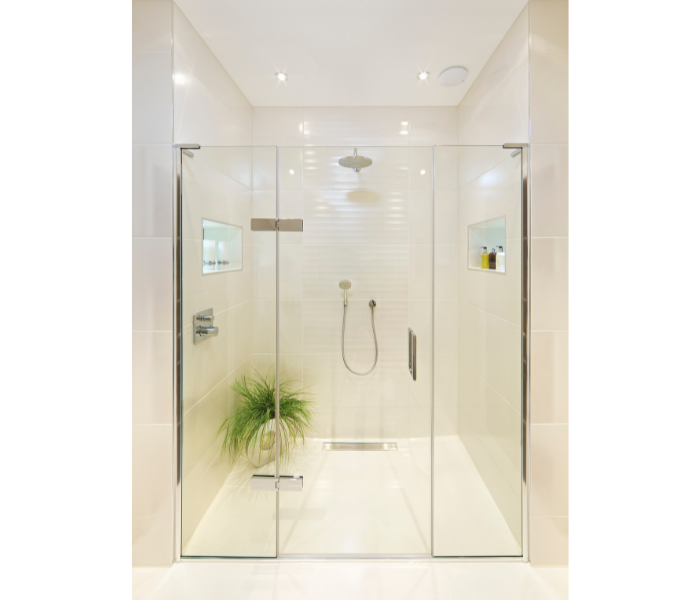
Walk-in shower installations in UK homes rose by over 35% between 2019 and 2024. Families driving that shift aren’t chasing a look, they’re solving a daily frustration
Forget those fancy hotel showers you see on Instagram with marble walls and huge shower heads. That is not what this is about. Instead, this is about whether a walk-in shower enclosure is the best choice for a normal, busy family home in the UK.
When you look at how a family bathroom actually gets used to the morning rush, kids’ bath times, messy teenagers, and guests, then the answer is a clear yes. It isn’t because it looks better or follows a trend. It is because it fits into real life more naturally. It is easier to clean, stays in good condition for longer, and creates a space that works well for everyone in the house.
In this blog, we will discuss why a walk-in shower is a better choice for a family bathroom.
Top Reasons a Walk-In Shower Is the Better Family Choice
Here are the top reasons a simple wet room screen or walk-in shower is a better choice for families.
The morning routine actually works.
No door to pull open when your arms are full of towels. No awkward step over a tray. No tight turn to reach the valve. A walk-in shower is just there. You walk in, you shower, you walk out. In a household where three people need the bathroom before 8 am, that ease of use is worth more than any feature on a spec sheet.
Cleaning takes minutes, not an afternoon.
This is the one families consistently say they didn’t expect to appreciate as much as they do. An enclosed enclosure has door hinges, frame channels, rubber seals, tray edges, and silicone joins where every one of them is a trap for soap scum, mould, and limescale. A walk-in shower with a single glass panel and a linear drain has almost none of that. A squeegee after each use and a weekly wipe. Done.
It doesn’t age badly.
The standard shower enclosures have a lifespan. Seals yellow. Chrome frames corrode, especially in hard water areas. Plastic trays scratch and stain. Most enclosed showers look noticeably tired within five to eight years. A semi-frameless or fully frameless wet room screen with good glass and quality fittings, a tiled floor that looks the same at 10 years as it did at 1. That longevity is a real financial argument, not just an aesthetic one.
It makes the whole bathroom feel bigger.
A glass enclosure divides a bathroom visually into zones. A walk-in shower, particularly with clear frameless glass, keeps the room reading as one open space. In the compact bathrooms most UK families are working with, that visual continuity is the difference between a bathroom that feels workable and one that feels cramped. The room doesn’t change size. It just stops feeling smaller than it is.
It works for everyone in the house.
An enclosed shower is fundamentally designed for one able-bodied adult at a time. A walk-in shower, with its open entry and flexible floor space, is easier for a parent supervising a young child, easier for a teenager who showers for twenty minutes and fills the room with steam, easier for a guest who doesn’t know where the door latch is, and easier for anyone who simply doesn’t want to navigate a hinged panel before they’ve had coffee.
Buyers notice it.
UK estate agents are consistent on this: a bathroom with a well-designed walk-in shower reads as a considered, high-quality space in a way that an enclosed enclosure simply doesn’t. It signals that the room was designed, not just fitted. That impression is fair or not, and it affects how buyers value the property. If you’re renovating with any eye on eventual resale, the wet room screens or walk-in shower is one of the highest-return bathroom decisions you can make
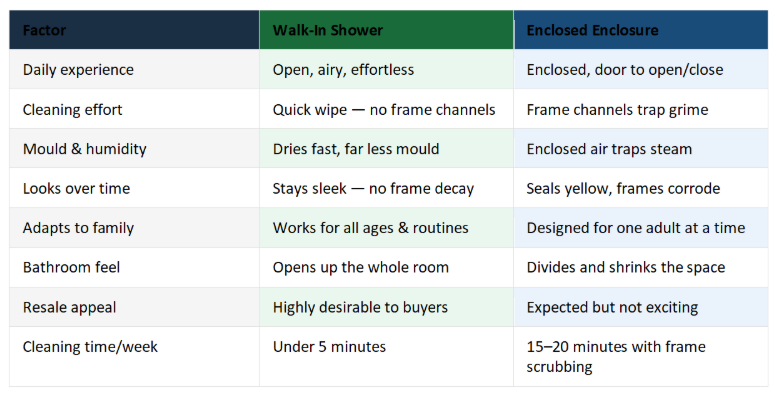
Walk-In vs. Enclosed: How They Compare Day to Day
Here’s an honest comparison across the factors that actually matter when you’re living with a shower every morning:
But I Don’t Have the Space — The Myth Worth Busting
Most UK homeowners assume walk-in showers require a large bathroom. It’s the most common reason people don’t consider them, and it’s largely wrong.
The minimum footprint
A functional walk-in shower needs 900mm x 900mm of floor space — identical to many enclosed enclosures. The difference is the absence of a door, a frame, and a raised tray. Same footprint, completely different feel.
The single fixed panel
For bathrooms under 5 square metres, which covers the majority of UK family bathrooms, a single fixed glass panel is the walk-in format that works best. One sheet of frameless glass, anchored at one end of the shower zone. It contains spray, defines the space, and looks considered without eating into the room. This is the format most UK bathroom designers specify first for compact family bathrooms.
You can keep the bath
A walk-in shower doesn’t mean removing the bath. The two can coexist, and in a family home, they probably should. The bath stays for children and evenings. The walk-in shower handles every adult morning. Both in the same room, with better layout planning rather than more square footage.
The Bottom Line
The enclosed shower enclosure became the default in UK family bathrooms because it was practical, contained, and affordable. For a generation of bathroom fitters, it was simply what went in.
Walk-in showers aren’t replacing enclosed enclosures because they’re fashionable. They’re replacing them because, for the way families actually use a bathroom daily, hurriedly, by multiple people with different needs, they work better. Easier in the morning. Easier to clean. Better looking for longer. More adaptable as the family changes.
If you’re renovating a family bathroom and asking which shower format you’ll still be glad you chose in ten years, the answer is the walk-in. Not because it looks better in a photograph. Because it works better in real life.